Showing posts with label Onward Christian Soldiers. Show all posts

Thursday, 10 August 2017

Discipline earlier to relax later

Parents are often wary of discipling their little ones when they are young. Pastor Jeffrey shows clearly why this is a disastrous and painful route to take. Here is a choice quote as a taster:
Raising a young child may at times feel like herding geese, but disciplining an unruly teenager is like trying to put a collar on a hungry bear, and repenting as an adult is like trying to turn a container sheep
Read the full thing here

Thursday, 13 April 2017

Faith in the face of fear - a message to those who kill us!

What the priest says below only makes sense if you know a Risen Saviour. Do you know Him?


Tuesday, 28 February 2017

Celebrating Lent properly

Tomorrow (Ash Wednesday) marks the start of Lent and in the next few weeks, it’s likely you’ll hear the question “What are you giving up for Lent?” How should we as Christians celebrate Lent? How can we celebrate it without the feelings of sombreness, despair and guilt that the season is often associated with? A couple of thoughts on this issue.

First, the way that the above question is phrased (What are you giving up?) gets us off on precisely the wrong note. It focuses on abstinence rather than activity, and on us rather than on Christ. If you're going to “do something” for Lent, make sure the focus is not on self-deprivation or inactivity. Instead, focus on devoting yourself positively to something spiritually beneficial such as half an hour reading your Bible or some other Christian book, a few minutes praying or meditating on and memorising some Psalms. Pursue abstinence or self-deprivation only if it helps you pursue these positive goals. Miss a meal, withdraw from Facebook or get up a bit earlier, for example, so that you can have more time to read and pray.

Second, remember that Sunday is still the Lord’s Day, i.e. Resurrection Day, even during the period of Lent. Strictly speaking, of course, the Sundays between Ash Wednesday and Easter aren't part of Lent at all. Do the sums: Ash Wednesday (1st March) to Holy Saturday (15th April) is 46 days; take away the 6 Sundays and you're left with the 40 days of Lent. Sunday is still a day of celebration, so let's keep it that way. Don't let Lent leak into Sundays. And one way to ensure this is by being at church every Sunday (including the Sundays in Lent) where we sing songs of praise and celebrate Holy Communion with joy.

Third, don't judge others who do things differently from you. Of course, it's possible to observe Lent in a spirit of more-pious-than-thou self-righteousness. It's also possible that not observing Lent may reflect an attitude of indifference and laziness with regard to our Christian discipleship. I'm not sure which is worse, and, thankfully, those are not the only options. But we all need to beware of assuming that we know why people are doing things differently from ourselves. The Apostle Paul's comments in Romans 14:3, though not written with Lent in mind, are certainly relevant here: “Let not the one who eats despise the one who abstains, and let not the one who abstains pass judgment on the one who eats, for God has welcomed him.”

May you have a meaningful Lent as you celebrate it properly!

Parish article for the week beginning 26th February 2017 AD (with thanks to SJ)

Saturday, 14 January 2017

The pastor is no specialist!

Christian theology especially in the late 20th century variety emphasised the comprehensiveness of the Christian faith. The notion that Christianity offers a worldview embracing every area of life was never more explicitly affirmed or more elaborately detailed. Think for example of the idea of Christian pop music, Christian counselling, Christian debt management (such as CAP) and so on. Related to this is the claim that every calling is good and noble, that all work can be devoted to the service of Christ, that all Christians are called to seek first the kingdom of God.

This good and necessary emphasis has often been accompanied, however, by a denigration of the pastoral ministry: All Christians, it is said, have a “full-time” ministry, so the pastor has no higher a calling than any other Christian. But this does not follow. Though all callings can be equally devoted to Christ’s service, not all callings are equal. In Scripture, the pastoral office is specifically tasked with equipping the saints for the work of ministry (Ephesians 4:11-12), with the ongoing teaching of the Word (2 Timothy 4:1-2) and with seeking the well-being of all God’s people (1 Peter 5:1-4).

Another way to put all this is to say that pastoral ministry is the broadest calling, a vocation to minister and to serve (cheerfully) men, women and children in every circumstance.

When sickness strikes, we call the doctor. When in legal trouble, we contact a lawyer. When made redundant, we sign up with an employment agency. When labour pains begin, we call a midwife or a doctor, and when we have breathed our last, the undertaker has his way. For each stage of life, each crises, we have our specialist.

The pastor however is no specialist. They are called to represent Christ and speak for and about Him in every kind of situation. When visiting the ill, when guiding the adulterer in the way of repentance, when seeking to encourage the entrepreneur whose business has folded, when rejoicing with new parents or mourning with those who grieve, the minster is tasked with presenting Christ for the aim of caring for, building up and strengthening God’s Church. Beside the doctor, beside the financial advisor, beside the care home assistant, stands the pastor. In the maternity ward, in the jail cell, in the home tense with marital strife, stands the pastor. At the baptism, the wedding service, the funeral, stand the pastor: a generalist in human crises, a generalist in moments of passage, a generalist particularly called to equip the whole body of Christ with the whole word of Christ.

There is one sense in which the pastor is a specialist. For every situation, they have essentially one word, the word of the gospel of Jesus Christ. Among the sick, the pastor’s concern is not only for healing but to indicate how suffering can be transformed into joyful witness. Among the poor, the pastor’s concern is not just how to pay next month’s bills, but to consider how poverty may strengthen faith in the goodness of the heavenly Father. At the bedside of the dying, the pastor’s concern is not just to ease pain but to hold forth the promise of resurrection life. It is for this that we are to pray for our ministers namely, that they would faithfully proclaim the Word of Christ as they joyfully serve all people and so build up God’s Church.

Words for PCC away morning (with thanks to PL)

Tuesday, 3 January 2017

New Year, New You - how to put the past behind you

Image result for new year new you 2017
New Year’s resolutions are no longer popular. This is partly because many people reckon that they would break them in the first twenty-four hours and so it seems easier not to make any at all. But I guess we shouldn’t let the possibility of defeat cause us to give up the fight altogether, before we’ve even begun. It is sometimes said that if you aim for nothing in particular, that’s exactly what you’ll achieve!

The question remains, however, how should we respond when we fail again to achieve our goals and aspirations. The Bible’s answer is to remind us that God is merciful and gracious, slow to anger and abounding in steadfast love… He does not deal with us according to our sins. … As a father shows compassion to his children, so the LORD shows compassion on those who fear him. …” The God of the Bible is someone who gives us a first, second, third, fourth chance and more, when we cry out to Him. Failure in God’s eyes is not grounds for rejection or abandonment. Rather, it’s an occasion for Him to pour out His steadfast love found in Jesus Christ. It is no wonder that the Apostle Paul (a former murderer) could write:

One thing I do: Forgetting what is behind and straining toward what is ahead, I press on toward the goal to win the prize for which God has called me heavenward in Christ Jesus.

Such confidence and future hope (despite a messy past) only makes sense if the good news of Jesus’ birth, life, death and resurrection are true. If the Gospel record about Jesus is false then we have no hope and each of us faces a bleak and anguished future in an eternal hell. As someone has put it “No Jesus = No life” but, “knowing Jesus = knowing life” – eternal life. Being a disciple of Jesus Christ gives us the confidence to put the past behind us and to look forward with great hope to that great and awesome Day when Christ returns.


So, rather than dwell on past failures and disappointments, why not bring them to Christ seeking His forgiveness and peace? Come along to church to find out more (Matthew 11:28) and don’t let your past distract you. Your past is past. Today is a brand new year!

Magazine article for January 2017 AD the Benefice of East Dean, Friston & Jevington

Tuesday, 27 December 2016

What a friend

If it were possible to arrange when, where and into what circumstance you were born what would you choose? A home of great wealth? A family of high privilege? Surroundings of exquisite comfort? Thankfully, the when, where and how of our birth is something that none of us could ever arrange – it is a gift from God. However, the one person who had full control of His birth chose a most unusual path. Consider this – if the powers that Jesus had were at our disposal, would we have decided upon the path that His life took? Surely not. We would have most likely opted for powerful parents, fabulous wealth, plush surroundings, and an easy life. But instead, Jesus chose for His upbringing a poor home in an oppressed backwater under the thumb of mighty Rome. He chose to be born in the land of the shadow of death (Isaiah 9:2, 6).  He entered our world at its darkest depths.
All this is made more remarkable when we grasp Jesus’ full identity. When the angel announces to Joseph who the baby in Mary’s womb is, he says:
“You shall call Him Emmanuel which means God with us.” (Matthew 1:23)
In other words, the Jesus who was once laid in dingy, dirty manger was no ordinary child but rather the King of Kings and Lord of Lords (Luke 1:32-33).  Doesn’t such an identity demand a certain level of pomp and ceremony?  Or at least dignity?  Or publicity?
However, Jesus’ coming into our world was in humility and shows how our God identifies with us in our frail humanity. To see the nature of God, we naturally look up to the heavens.  Christmas tells us to look down into the manger; there is true deity.
Our God does not simply give orders from on high and bid us get on with it. NO! He comes down to earth in the flesh, living the life we could never live, and then dying the death we all deserve. It by this humility and great suffering that Jesus now offers to us the joy of sins forgiven and the wonderful promise of life everlasting. As the words of the opening carol at most candlelit services puts it:
He was little, weak, and helpless,
Tears and smiles like us He knew
And He feeleth for our sadness
And He shareth in our gladness

Or more simply:
“What a friend we have in Jesus – all our sins and griefs to bear.”

May we know this wonderful Jesus this Christmastide and beyond.
Parish article for the 12 days of Christmas, December 2016 AD

Monday, 12 September 2016

Put away the Che Guevara t-shirts, stop the revolution and go to church!

Image result for ordinary church
Kevin De Young makes a wonderful and compelling case why you should be at church every Sunday. Here's a taster:

Don’t give up on the church. The New Testament knows nothing of churchless Christianity. The invisible church is for invisible Christians. The visible church is for you and me. Put away the Che Guevara t-shirts, stop the revolution, and join the rest of the plodders. Fifty years from now you’ll be glad you did.

Sunday, 11 September 2016

15 years after 9/11: a Christian reflection

11th September 2001 is a marker in world history. It is the "where were you when..." moment of our generation. Much like July 20th 1969 was to a previous generation (Armstrong landing on the moon) and May 8th 1945 to a generation before that (V-E day), 9/11 is a day when everyone remembers what they were doing when they first heard or saw the news.

Sadly, since then the fears and anxiety created by terrorist threats have become an ever present reality. We wonder if we will ever be free of that sense of unease in our lives. Recent events including the murder in Paris of an 80 year old priest celebrating communion, continue to feed that unease. 

Therefore, on this the 15th anniversary of the 9/11 attack, it is worth pausing to consider how Christians should respond when horrible things happen (whether it be the carnage resulting from Islamic terrorism or an unexpected diagnosis in health or the sudden death of a family member). As someone has put it “Where is God when it hurts so bad?”

Part of the answer Scripture gives, is that the sadness we feel when bad things happen is one of God’s ways to tell us that this world is not all there is. The book of Ecclesiastes puts it like this:

“God has made everything beautiful in its time. He has also set eternity in the hearts of men.”

In other words, the world is filled with much that is good and lovely but often things/people/circumstances ‘interrupt’ our joy causing us to wonder if this life is all there is. When, for example, relationships end and we feel heartbroken or when death strikes and we experience desolation, these are huge pointers to our longing for eternal life. All of us yearn for a world where there is no suspicion (of potential terrorists or of anyone else), where there is no need for scanners (at the airport or at the DGH) and where there is no sinfulness (big and public as at 9/11 or small and hidden such as anger or lust).

Astonishingly, the Bible offers us the chance to be part of such a wonderful sin-free world for ever! It is an offer which comes through a man – Jesus Christ – who lived the perfect life that none of us ever could and who died the death that each of us deserved. It is only by believing in His death and resurrection that God promises eternal life (rather than everlasting torment) – a life where there will be no more sickness, suffering or sorrow but limitless joy!

The phrase is true for the Christian believer: all will be well in the end. May we – whatever our suffering – put our trust in Christ as we await that day when all truly will be well, where evil will be finally overthrown and where Christ will welcome all who trust in Him into His everlasting kingdom. Amen.

Parish magazine article for 11th September 2016 AD

Saturday, 26 March 2016

Our God dies to conquer death. Can yours do that?

No human experience is closed to God. We cannot put a sign outside any area of human life that says “God has no business here,” “God may not enter.” We [may] set up obstacles and roadblocks, but the Lord bursts in regardless...
                                                                                                  ...Jesus’ death does not contradict His sovereignty. It is a revelation of His sovereign Lordship. Jesus’ life and death reveals that God is Lord not only over all things He is Lord in all things.

Read more of that here

Thursday, 18 February 2016

Mission agencies are you listening?

In my opinion, Africa doesn't need missionaries from other continents in the same way they may have in past generations. Africa needs Africans, whatever colour, to be trained to minister to their own people. 
A salutary word to many of the mission agencies among whom it has been all the rage to talk about (and prioritise) reaching the unreached. Whilst I understand this zeal for evangelization, I have become convinced that for most of sub Saharan Africa what is most needed is not so much the reaching of the lost, as it is to disciple of the nations. This in fact is what Jesus calls the Church to do and something that is often overlooked in the Great Commission.

Tuesday, 16 February 2016

Tuesday, 26 January 2016

Luther's recommendations for your devotions

“You should diligently learn the Word of God and by no means imagine that you know it. 

Let him who is able to read take a psalm in the morning, or some other chapter of Scripture, and study it for a while. This is what I do. When I get up in the morning, I pray and recite the Ten Commandments, the Creed, and the Lord's Prayer with the children, adding any one of the psalms. I do this only to keep myself well acquainted with these matters, and I do not want to let the mildew of the notion grow that I know them well enough. The devil is a greater rascal than you think he is. You do as yet not know what sort of fellow he is and what a desperate rogue you are. His definite design is to get you tired of the Word and in this way to draw you away from it. This is his aim.

Let the man who would hear God speak, read Holy Scriptures.”

Tuesday, 22 December 2015

How to avoid disappointment this Christmas Day

Holidays are frequently times when people get trapped by the expectations game. Because everyone around you assumes that the day is going to be “really good”, “special” or “fantastic” and is constantly telling you to have a “merry Christmas”, it is easy to assume that having a good Christmas is something that happens easily. Consequently, there is a tendency to expect that it will be a good Christmas only to be disappointed when the day arrives. Boxing Day comes and it feels like you got socks instead of the iPhone or cookware instead of the pearls. This is one of the main reasons why Christmas can be such an emotional roller coaster ride for many. So, how are we to avoid the disappointment of failed expectations? It is by preparing ourselves spiritually for the coming celebrations. Here are some helpful words from the Apostle Paul:

“As God’s chosen ones, holy and beloved, clothe yourselves with compassion, kindness, humility, meekness, and patience. 13 Bear with one another and, if anyone has a complaint against another, forgive each other; just as the Lord[f]has forgiven you, so you also must forgive. 14 Above all, clothe yourselves with love, which binds everything together in perfect harmony. 15 And let the peace of Christ rule in your hearts, to which indeed you were called in the one body. And be thankful” (Colossians 3:12-15).

One of the best ways to prepare for the Christmas holidays is by cultivating thankfulness in your heart to receive with gratefulness whatever this season will bring. As Christians, we have so much to thank God for – for life, health, family, friends, for the lovely part of the world we live in. Most of all we have the Lord Jesus Christ; the one who came, lived and died that we might be forgiven. If God has given us all this, not least His precious and beloved Son, why do we then grumble at not getting the latest gadget or getting costly jewellery? Start preparing your heart now/today for Christmas (and beyond that the New Year) by being thankful for the many gifts God has given you (and will give you) and you will find this Christmas (and beyond) a more joyful time.  May you have a merry Christmas and a happy new year 2016.

Thursday, 17 December 2015

True community at Christmas time

One of the things that helps make up a Christian community are the misfits, the people who don’t quite fit in community. If everyone fit perfectly, we would have a jigsaw puzzle of a twee painting much like a picturesque National Trust postcard and not a gathering of real people. Real community has real problems.

But there is a difference between Christians who are kind of angular, on the one hand, and those who live in such a way to destroy community on the other. The former sort of problem is the kind of thing that love is designed to cover a multitude of, and can frequently do so without even thinking. But the latter is the sort of thing that every healthy community must view with a divinely-given hostility.

What sorts of things are found in the latter category? The Apostle Paul gives us these examples: “sexual immorality, impurity, debauchery, idolatry, witchcraft, hatred, discord, jealousy, fits of rage, selfish ambition, dissensions, factions, envy, drunkenness and orgies.” He then adds this warning: “Those who live like this will not inherit the kingdom of God” (Galatians 5:20-21.

Of course this is not saying that such sins cannot be forgiven. Christ came to die for our sin – all sin. However to indulge in the evils listed above is one sure way to destroy good fellowship and could eventually result in you missing out on eternal life. What then is the solution? It is to be totally honest with regard to our sin. Dishonesty is in fact one of the key ways that community and fellowship is destroyed and which also leads to our being cut off from God. One important way then to be preparing for Christmas is by being truly honest with yourself and if there is anything evil in your life to seek the LORD in repentance and turn to Him in faith so that you’re in true fellowship with Him and consequently in good fellowship with each other.

I began by saying that misfits must be present for true community to exist. But let us also never forget that, in various ways, and in various settings, all of us are misfits. True community lets love cover it, but all of us must do the covering, and all of us have things that must be covered. Christ, remember came for misfits and heaven, after all, will be filled with people who used to be misfits. As Jesus puts it: “I came not to call the righteous but sinners to repentance.” (Luke 5:23). That indeed is the reason for the season.

Parish magazine article for the 3rd week in Advent 2015

Friday, 30 October 2015

Celebrating Halloween like a Christian

What does God think of Halloween? How are Christians to respond to all the spooky outfits, scary masks, witches hats that dominate the scene at this time of year? Should we simply retreat, batten down the hatches, avoid all shops and hope no one knocks on Wednesday night? Before answering that question allow me, to share with you my top tip, that I think is guaranteed to ruin any good party (never say that I am not a generous person)! So imagine the scene; you’ve arrived at a party – the venue is lovely, the music is playing, the food is fantastic, conversations are flowing, everyone you want is there and at this point in the party, no one has done anything silly or embarrassing. No one has been on the dance floor and made a fool of themselves, no has attempted to sing along to the music in a tone deaf way, no one has had too much to drink and started acting a bit silly. All told, everything is going well so far. Well here is how to ruin the party. Just wait until there is a bit of a pause, perhaps, after someone has cracked a really good joke and then raise your voice a little and say “I tell you what, this seems like a good time to speak about death!”

That would be it wouldn’t it? To wait until everyone is having fun, the party is in full flow and people are enjoying themselves and then mention the dreaded d-word: death.

Now here is the link with that anecdote[1] and Halloween. When you see the sorts of outfits that are sold in the shops and supermarkets at this time, isn’t it as if our society says ‘let’s have a party, a celebration, a festival, and use it, to talk about death’ – isn’t that what it’s like when you come across the scary, horrible-looking, death-imitating costumes in the shop aisles? Don’t they just scream “death” and remind us of this horrible enemy in our midst?

Well here is a first surprise as we return to our opening question of how are Christians to respond to Halloween. The first surprise is this – Christians (unlike the world/non-believers) have a good reason to celebrate Halloween by putting on scary costumes and joking about death etc because unlike the world we have a King, Jesus Christ, who has conquered, triumphed and overcome death. We Christians have a Saviour, Jesus Christ, who has experienced this horrible enemy death, but who thankfully has defeated it (Hebrews 2:14-15). As Paul asks provocatively in 1 Corinthians 15:55

Where, O death, is your victory?
    Where, O death, is your sting?

His answer: thanks be to God who gives us the victory through our Lord Jesus Christ. Those who are united to this Jesus Christ have every reason not to fear death. Christians can look death in the eye and say “horrible though you are O death, one day... one day we will have the last laugh on you”. We Christians can mock death because even though we know that it is horrible and painful and sad, yet we can still laugh at it because we have a Saviour who has completely triumphed and defeated death. Christians need not therefore fear these scary costumes that appear at this time of year, and we should be free to mock death by wearing ghoulish outfits as a mock on this defeated enemy – death.

If you’ve seen the film Crocodile Dundee, you’ll know that there’s a scene where the main character, Dundee is walking home late one evening when he gets accosted by 3 kids wanting to mug him. The lead member pulls out a penknife and shouts “give us your wallet” and Dundee’s girlfriend in a bit of panic, urges him to respond quickly by giving the thugs his wallet. Dundee retorts by asking “Why?” to which she replies “because they’ve got a knife” And Dundee’s comical response is to say “That’s not a knife... here’s a knife” as he draws out a machete! And it’s a little like that with the victory accomplished by our risen, reigning Lord. You can imagine him looking at all the scary outfits which people don at this time of year and saying “You think that is scary? Wait until you see the fierce dragon that I had to fight. He is horrible and cruel and everyone he attacks loses. Everyone that is, except Me”.

Halloween then can and should be for the Christian a time to laugh. Not a fake, shallow, pretend laughter, but the kind of laughter which is filled with a certain hope that even though the present may be painful, even though the present may be full of tears and sadness, yet in Christ we are confident that our sorrows will be turned to joy.

Here is the second surprise related to Halloween. Modern day Christians should reclaim the celebration of Halloween, given that it was our forbears who encouraged people to wear scary outfits as a parody of death. Halloween as you may know was originally known as All Hallows Eve. It is the day before All Hallows/All Saints Day, when the Church remembers those who have died in the faith and give thanks for their faithful witness. All Hallows Eve therefore was (and is) an occasion to tease death by reminding ourselves of the wonderful hope of the final resurrection as we give thanks for those who’ve fallen asleep in Christ. The medieval Church thus encouraged Christians to wear frightening and death-imitating costumes not because they were morbid or because they didn’t have access to GAP or Calvin Klein but rather because they were confident that death had been defeated. Christians therefore wore horrible outfits not because of a lack of fashion sense but to satirize death and say to it, ‘you’re a loser!’ or more positively ‘we will win!’ This by the way is the reason that many old churches and some grand buildings have gargoyles. Have you ever wondered why someone would build a beautiful church with intricately designed mosaics, pretty stained glass windows, ornate looking furniture and then include unappealing and oftentimes scary looking gargoyles? Well the reason was simply to say to the congregation (and to the world) that though death may still be present among us (which is what these gargoyles pictured) yet in Christ, we shall overcome. In other words, gargoyles were a visual way of saying that the medieval Christians were not afraid of death.

It is reported that Woody Allen when once asked about death responded “I’m not afraid of death I just don’t want to be there when it happens.” How different for the Christian! This Halloween then, let us not fear... let us not fear the frightening costumes, let us not fear the knock on the door, let us not fear the future and crucially let us not fear death. And why not think of a tangible way (including perhaps wearing a scary costume?) to teach and share with your family and friends, that in-Christ, death is not the end!


[1] Taken from Lee McMunn’s Identity course, Session 4 “The God who comforts us” 

Monday, 3 August 2015

Why Obama was wrong, Uhuru too soft and Ruto right (on this occasion)

Obama inspects a guard of honour while the 'beast'
lurks in the background
So now the dust has kind’a settled and as a Kenyan in the diaspora, it has been fascinating observing how Obama’s visit to his ‘motherland’ was perceived. In Kenya, the excitement and frenzy was tremendous and even now over a week after the visit, newspaper editorials continue to reminisce on the significance of the first sitting American president to visit Kenya – and one of our own to boot! Obama’s Kenyan family have shared publicly that the president promised them he will visit the country again soon while TV programmes continue to be dazzled by the paraphernalia that accompanied the president, like his supersized car, also known as the ‘beast’. Here in the UK, it was noticeable that the visit made lead news for 2 days running on the BBC. It was featured in most newspapers and online newsfeeds and even made the front page for an important UK broadsheet - The Observer. Unsurprisingly for the UK (western?) press the item that got the most coverage was Obama’s championing of gay rights. Part of the reason for this were the following remarks made by Kenya’s Deputy President, William Ruto, prior to Obama’s visit:

“Homosexuality is against the plan of God. God did not create man and woman so that men would marry men and women marry women. We have heard that in [the] US they have allowed gay relations and other dirty things I want to say as a Christian leader that we will defend our country Kenya, we will stand for our faith and our country.”
In a special interview by the BBC where Obama was asked about Ruto’s comments, he responded:

“Yeah. Well, I disagree with him on that, don’t I? And I’ve had this experience before when we’ve visited Senegal in my last trip to Africa. I think that the president there, President Sall, is doing a wonderful job in moving the country forward – a strong democrat. But in a press conference, I was very blunt about my belief that everybody deserves fair treatment, equal treatment in the eyes of the law and the state.”
There had been talk that Obama would not shake Ruto's hand
but he was all smiles when he met Ruto at State House.
Given the entrenched views on both sides and the antipathy with which homosexuality is viewed in Kenya (and Africa more widely) there had been speculation that, when in Kenya, Obama would duck the gay issue and focus instead on security and trade. This however did not happen. Perhaps emboldened by his actions and statements in the US and the recent Supreme Court’s decision to redefine marriage, Obama ventured to speak up for so called “gay rights,” albeit in a more muted form than in his native land. A key strand in Obama’s answer was his personalising of the issue by comparing homophobia to the racial discrimination that he had encountered in the US. Here is what he said:

I’ve been consistent all across Africa on this. I believe in the principle of treating people equally under the law, and that they are deserving of equal protection under the law and that the state should not discriminate against people based on their sexual orientation.  And I say that, recognizing that there may be people who have different religious or cultural beliefs. But the issue is how does the state operate relative to people.
Moments before that interview and both men are smiling but it was Uhuru
that would have the last laugh when he gave
Obama's 'gay rights' agenda the short shrift
If you look at the history of countries around the world, when you start treating people differently -- not because of any harm they’re doing anybody, but because they’re different -- that’s the path whereby freedoms begin to erode and bad things happen.  And when a government gets in the habit of treating people differently, those habits can spread.  
And as an African-American in the United States, I am painfully aware of the history of what happens when people are treated differently, under the law, and there were all sorts of rationalizations that were provided by the power structure for decades in the United States for segregation and Jim Crow and slavery, and they were wrong.  
So I’m unequivocal on this.  If somebody is a law-abiding citizen who is going about their business, and working in a job, an obeying the traffic signs -- (laughter) -- and doing all the other things that good citizens are supposed to do, and not harming anybody -- the idea that they are going to be treated differently or abused because of who they love is wrong.  Full stop.  
And the state does not need to weigh in on religious doctrine.  The state just has to say we’re going to treat everybody equally under the law.  And then everybody else can have their own opinions.  All right?

Notice how Obama repeatedly frames the issue in terms of pursuing equality and in particular, a desire that people be not treated differently – by the State – because of ‘who they love’. As a parallel to the experiences of homosexuals when they are treated differently (as is the case in Kenya where homosexuality is punishable with up to 14 years imprisonment), Obama pointed to the painful history of segregation experienced by African-Americans in the US.

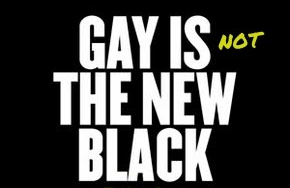
As a black Christian, I am getting increasingly tired and offended at this persistent comparison between race and gender to promote homosexuality. Why do people perpetuate this comparison to justify the sin of homosexuality? Can anyone show me where in Scripture one’s sin colour is described as wicked or evil? Yet I can think of numerous texts that explicitly condemn homosexuality and sex outside of marriage. More and more I’m becoming convinced that those who trot out this comparison have not actually read the Scriptures carefully but are attempting to deploy an emotive argument to defend a wicked and sinful act. If I had 5 minutes with Obama, I would urge him to start by considering Jesus’ words in the Sermon on the Mount (especially chapter 5 v 27-32) as well as his comments on divorce, all of which make clear that sex/marriage only exists between a man and woman in the context of marriage. Added to this are St Paul’s clear denunciations (e.g. Romans 1:18-27, 1 Corinthians 6:9-11) which leave no wiggle room for the biblical view that homosexuality (among other sexual sins) are things to be repented of and which only Christ can redeem. A failure to do so (as with all other sin) will lead in the end – Scripture warns us – to eternal judgement.

None of this though was mentioned by the Kenyan president, Uhuru Kenyatta in his response to Obama. Instead Uhuru completely sidestepped Obama’s equality message and focussed instead on the prevalent view in African society that homosexuality is un-African. This is what Uhuru said:

“…the fact of the matter is that Kenya and the United States, we share so many values -- our common love for democracy, entrepreneurship, value for families.  These are things that we share.  But there are some things that we must admit we don’t share -- our culture, our societies don’t accept.  It is very difficult for us to be able to impose on people that which they themselves do not accept.  
This is why I repeatedly say that, for Kenyans today, the issue of gay rights is really a non-issue.  We want to focus on other areas that are day-to-day living for our people:  The health issues that we have discussed with President Obama.  These are critical.  Issues of ensuring inclusivity of women, a huge section of society that is normally left out of the mainstream of economic development.  What we can do in terms of infrastructure; what we can do in terms of education; in terms of our roads; in terms of giving our people power, encouraging entrepreneurship.  These are the key focuses.  
Maybe once, like you have overcome some of these challenges, we can begin to look at new ones.  But as of now, the fact remains that this issue is not really an issue that is on the foremost mind of Kenyans, and that is the fact. 
Notice that unlike Obama, Uhuru never explicitly states what his views on the subject of homosexuality are. Instead his response comes across as a mere respecting of the will of the people and a desire not to impose on the citizenry what they do not accept. Uhuru’s answer therefore never addresses the morality of homosexuality. Is it wrong or is it right? Is it evil or is it good? Is it beneficial or harmful? Uhuru’s answer never makes this plain and for this reason is actually open to the charge of homophobia. If the principle reason why Uhuru is not keen on gay rights is because it is the majority view currently, what happens when it ceases to be? Furthermore, isn’t it the responsibility of good leaders to make decisions that they believe are right irrespective of what public thinks because ultimately such decisions will be for the good of the people? Because Uhuru’s answer gave no moral framework apart from his concern to respect the wanainchi[i], the question arises: what if they are wrong, what if their antipathy for homosexuals is because they think they are easy targets? Let’s change the subject for a moment. Consider Nazi Germany. By all accounts Fascism was hugely popular in 1930’s Germany and accepted by the majority of the German people. If one were to employ the same lines of argument Uhuru deployed in response to Obama, it is difficult to see how he could condemn Nazism given its popularity then. If one were to rely simply on what is prevalent in a society, one would be on shaky ground indeed. The solution then – especially for those who claim to be followers of Christ – is to frame our responses in moral categories. It is never good enough to depend on the populace when justifying a viewpoint, action or policy. As a former dean of St Paul’s Cathedral in London once put it: Whoever marries the spirit of the age will find himself a widower in the next. To avoid such a fate, our call as Christians is to state clearly when called upon why certain actions are wrong (e.g. homosexuality, adultery and polygamy to name but a few) and to do so by referring to the God of Holy Scripture who has kindly revealed clearly His good and perfect will for humanity. I therefore find myself in the unusual position of agreeing with the Deputy President – William Ruto when he described Homosexuality as dirty and as being against the plan of God. Or as Jehovah the LORD succinctly puts it: thou shall not lie with mankind as with womankind: it is an abomination. Indeed.


[i] Wanainchi is Swahili for the locals

Wednesday, 17 June 2015

Suffering is never for nothing

Elisabeth Elliott (who died Monday) here reflects on the major suffering she experienced in her life.


Monday, 13 April 2015

How do we prepare for death, and die, as Christians?

In the end, the whole Christian life may be seen as an extensive preparation for death. We trust Christ to forgive our sins; likewise, we trust him to bring us through the doorway of death safely. We trust Christ with a million things everyday of our lives as we move through this danger-filled world; likewise, we trust him to bring us through the passageway that leads from this world to the next. The way to die as a Christian is to live as Christian: We entrust ourselves into the loving embrace of our Savior, confident that he is with us and will protect us in life and in death, in history and in eternity, in this world and in the world to come. He is our comfort, our joy, our salvation. He is the Resurrection and the Life. His death does not exempt us from the burden of having to die, but it does transform our death. Because he died for us, we shall live in him. Because he died for us, even in the moment of our death we are victorious.

Via Rich Lusk on a post covering death and resurrection before the fall, 'death' and resurrection in the Trinity, how Christians can view death as an friend and the place of anointing the sick in evangelical piety. There is material here to meditate on for a lifetime!

Thursday, 9 April 2015

Is this why there are few men as missionaries?

Hudson Taylor, the founder of Overseas Mission Fellowship (formerly of China Inland Mission) once described missionary work as follows:
The work of a true missionary is work indeed, often very monotonous, apparently not very successful, and carried on through great and varied but unceasing difficulties

Is this why there are very few men as missionaries? The 2 mission agencies (British) that I am familiar with have a ratio of about 3 women for each man. I am sure there are many other reasons for that but I wonder if one of the major ones is the male aversion to hard work? Speaking as a man (and from my experience as a pastor) I can say that men sadly are often more willing to let someone else fulfil their spiritual responsibilities, whether it be their wives, their mothers, their children (!) or their government. How very different to the Real and True Man who never shirked back from hard work

Wednesday, 11 March 2015

Most disagreements do not require division, they require vision

Praise the Lord for Toby Sumpter who repeatedly comes up with such wonderful insights as this one:

Of course there are disagreements that sometimes require division, but most disagreements do not require division, they require vision. They require a renewed vision of the big picture, the death and resurrection of Jesus, the gift of the Holy Spirit, the forgiveness of sins, the Church triumphant marching gloriously through history – when you step back and catch a glimpse of this vision, joy wells up inside you and when you glance back at your differences, those differences seem small and insignificant.

Praise the Lord indeed.