Saturday, 30 March 2013

10 reasons why the Resurrection matters

1) It makes salvation possible

2) Without believing the Resurrection, you cannot be saved

3) It confirms the reliability of the New Testament

4) It gives us hope of the new life to come

5) Jesus' resurrection previews what our bodies will be like

6) The resurrection demonstrates that God the Father accepted Christ’s suffering as a full payment for sin

7) The resurrection displays the magnitude of power available to Christians in their struggle against sin 

8) The resurrection motivates us to turn away from sin 

9) The resurrection proves the reliability of Old Testament prophecy

10) The resurrection confirms that Jesus was the Son of God

There's more explanation of the 10 here BUT the take home point is that we should make sure our Easter celebrations have more to them than just eggs and feasting. Eggs and feasting are good but they should be a jewel in Christ's victorious crown over death. 

He is risen, Alleluia Alleluia

Wednesday, 27 March 2013

No lover of Christ


You are no lover of Christ if you do not love his children. As soon as ever the heart is given to the master of the house it is given to the children of the house. Love Christ and you will soon love all that love him.

C.H. Spurgeon [who I think was riffing off John 15 and 16 and 1 John 3 and 4]

Tuesday, 26 March 2013

The folly of democracy

Alexander Fraser Lytler (also Lord Woodhouselee) had it right:
A democracy cannot exist as a permanent form of government. It can only exist until the majority discovers it can vote itself largess out of the public treasury. After that, the majority always votes for the candidate promising the most benefits with the result the democracy collapses because of the loose fiscal policy ensuing, always to be followed by a dictatorship, then a monarchy.
And for evidence I present you a snapshot of the British public's sympathies and their overwhelming socialist tendencies:

Friday, 22 March 2013

Best intro to an essay?

Virginia Woolf's intro to her essay On Being Ill has got to be one of the greatest opening lines in essaydom:
“Consider how common illness is, how tremendous the spiritual change that it brings, how astonishing, when the lights of health go down, the undiscovered countries that are then disclosed, what wastes and deserts of the soul a slight attack of influenza brings to view, what precipices and lawns sprinkled with bright flowers a little rise of temperature reveals, what ancient and obdurate oaks are uprooted in us by the act of sickness, how we go down in the pit of death and feel the waters of annihilation close above our heads and wake thinking to find ourselves in the presence of the angels and the harpers when we have a tooth out and come to the surface in the dentist's arm-chair and confuse his "Rinse the mouth-rinse the mouth" with the greeting of the Deity stooping from the floor of Heaven to welcome us - when we think of this, as we are so frequently forced to think of it, it becomes strange indeed that illness has not taken its place with love and battle and jealousy among the prime themes of literature” 
I know she was a rank pagan of the highest degree but don't you wish you could write something like that?

Wednesday, 20 March 2013

Do infertile couples clinch the same-sex marriage?


Nope. All infertilities are not equal. There is a crucial difference between an infertile heterosexual union and an impotent homosexual one.


Read the fuller explanation here BUT, be warned, there's some candid and forthright language therein

Tuesday, 19 March 2013

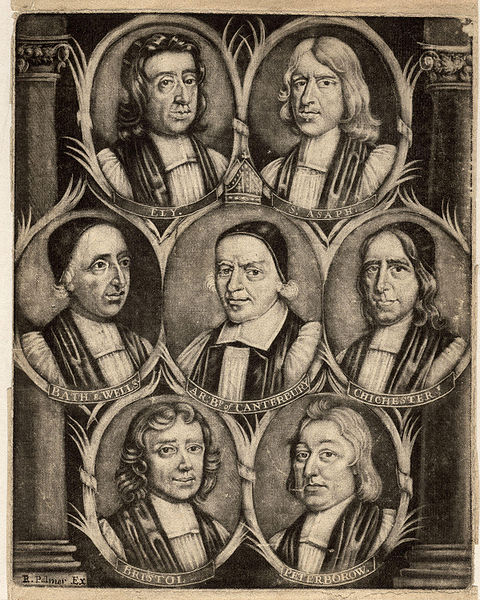
Wish they still made Bishops like TK


File:The Seven Bishops Committed to the Tower in 1688 from NPG (2).jpg
The 7 Bishops committed
to the tower in 1688, among them, the
then Archbishop of Canterbury, William Sancroft.
Today the Church remembers Thomas Ken. He was an Anglican clergyman who was at one time the Bishop of Bath and Wells and more famously, author of the well-loved doxology Praise God from whom all blessings flow (which is actually the last verse of his longer hymn Awake my soul, and with the sun). He was by all accounts a man of principle and firm conviction and was one of the seven bishops who was imprisoned for refusing to sign James II's "Declaration of Indulgence" (which was meant to allow Roman Catholics to resume positions of political power in England). Later in life, he was deposed as Bishop for refusing to take an oath of allegiance to the co-monarchs, William and Mary because in Ken's view it would make a mockery of an earlier oath he'd made to James II, who was still alive (even though he strongly disagreed with much that James had formerly done). If only they still made Bishops like that today, where would the Church of England be? Here is a prayer of Thomas Ken:

God, our heavenly father, make, we pray, the door of this Cathedral Church [Wells] wide enough to welcome all who need human love and fellowship and a Father’s care; but narrow enough to shut out all envy, pride, and lack of love. Here may the temped find help, the sorrowing receive comfort, the careless be awakened to repentance, and the penitent be assured of your mercy; and here may all your children renew their strength and go on their way in hope and joy; through Jesus Christ, our Lord. Amen.

Monday, 18 March 2013

Luther's last words: well known in heaven, on earth and in hell

Well not quite Luther's last words but almost... the line actually read: "Finally, I also ask of every man [...] that he would allow me to be the person which I in truth am, namely, a public figure, known both in heaven and on earth, as well as in hell" and was in fact one of the closing sentences of Luther's last testament and will. A reflection perhaps of the bold stance he had taken throughout his life. Luther's actual last words are purported to be:

"We are beggars. This is true."

Which apparently came about in a conversation with a friend Justus Jonas who had asked whether Luther was going to die "standing firm on Christ and the doctrine [he] had taught?" to which he replied "Yes!" and concluded "We are beggars. This is true." Here is someone who understood our total dependence on God  and the fact that apart from Christ we can do nothing and destined for destruction (John 15:5-6). Or as that great hymn of old puts it:

Guilty, vile, and helpless we;
Spotless Lamb of God was He;
“Full atonement!” can it be?
Hallelujah! What a Saviour!